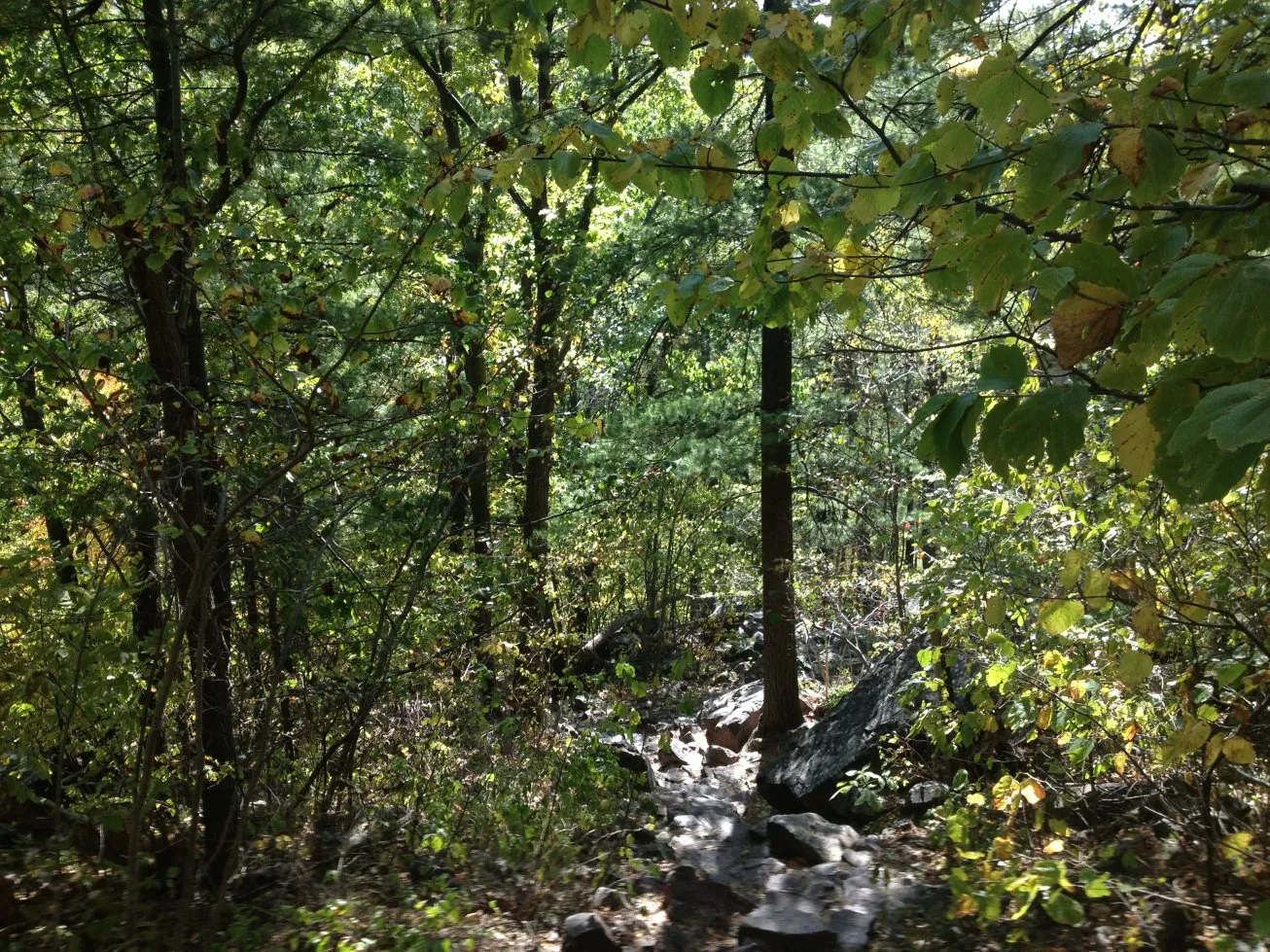

Devil’s Lake State Park labels its trails with three words: Easiest, More difficult, Most difficult [1]. Here’s a coach’s secret: everyone who’s ever done the “Most difficult” ones started on the “Easiest.” Every single one.
So that’s where you’ll start, too. A level gravel path beneath the East Bluff. A lakeshore walk through giant tumbled boulders. A level loop past beaver ponds. Then, when you’re ready, the bluffs.
At a glance
Plan your week
| Moderate minutes brisk walk, easy bike | Vigorous minutes run, hard hike, class | Strength | |
|---|---|---|---|
| Mon | |||
| Tue | |||
| Wed | |||
| Thu | |||
| Fri | |||
| Sat | |||
| Sun |
Based on the federal Physical Activity Guidelines for adults: 150 minutes of moderate activity a week (each vigorous minute counts as two), plus muscle-strengthening on at least 2 days. Check with your doctor before starting a new exercise plan, especially if you have a health condition. Plug in the free Wisconsin spots from this guide.
Devil’s Lake State Park
Devil’s Lake has 29 miles of trails, from easy strolls on a paved path along the lakeshore to a rocky climb up the south face of the East Bluff [1]. About 1.5 miles of trail are accessible for people with disabilities, including parts of the Tumbled Rocks and Grottos trails and the south-shore sidewalk and boardwalk [1].
| Trail | Length | What it's like |
|---|---|---|
| Grottos Trail | 0.7 mi | Level gravel path along the south face of the East Bluff |
| Tumbled Rocks Trail | 1 mi | The park's most popular: lakeshore path through boulder fields below the West Bluff |
| Group Camp Trail | 0.5 mi | Rated Easiest |
| Steinke Basin Trail | 2.4-mile loop | Level, partly grassy, partly wooded; small streams with signs of beavers |
| Johnson Moraine Trail | 2.8 mi | Rated Easiest |
Your first visit: walk the Grottos Trail out and back. It’s level, it’s smooth, and you’re walking beneath the East Bluff the whole time [1]. Then head to the north shore for Tumbled Rocks, a lakeside path with great views from water level. The northern half is roughly paved [1].
Your second visit: the Steinke Basin loop, 2.4 level miles across what was once a shallow glacial lake bed [1]. That’s a real hike. You’re doing it.
Save for later: the bluff climbs. The Balanced Rock, Potholes and C.C.C. trails are all rated Most difficult. They’re short, 0.3 to 0.4 miles, but the park describes them as steep climbs on stone steps, “more like an uneven rocky staircase” [1]. The East Bluff Trail (1.7 miles) is also Most difficult [1]. You’ll get there. Build the legs first on the flat trails, and the steps will feel like a victory lap.
What a Wisconsin state park pass costs
Every vehicle needs an admission pass at Wisconsin state parks and forests. Rates in effect since Aug. 19, 2025 [2]:
| Vehicle | Daily pass | 12-month pass |
|---|---|---|
| Wisconsin plates | $13 | $28 |
| Wisconsin plates, resident 65+ | $3 | $13 |
| Out-of-state plates | $16 | $50 |
If you go even three times a year, the $28 annual pass beats paying daily. And if you skip paying before you use a park, there’s an extra $5 fee, and you can be cited [2]. The DNR also waives admission in some cases, such as for disabled veterans, Wisconsin resident active-duty service members and on Free Fun Weekend in June [3].
Our guide to staying active through a Wisconsin winter covers state trail passes, candlelight hikes and free ski trails.
The Ice Age Trail: 1,200 miles, one segment at a time
The Ice Age National Scenic Trail spans 1,200 miles across Wisconsin, through some of the state’s finest glacial features [5]. It’s built and maintained by volunteers, the Ice Age Trail Alliance, the Wisconsin DNR, local partners and the National Park Service [5].
Here’s the beginner move: you don’t hike the Ice Age Trail. You hike a little piece of it. Find the segment nearest you, walk 20 minutes out and 20 minutes back, and tell people you hiked the Ice Age Trail. Because you did.
Deer season: be seen
Wisconsin’s 2026 gun deer season runs Nov. 21 to 29, with a muzzleloader season Nov. 30 to Dec. 9 and archery and crossbow seasons running into January [4]. If you hike in fall, wear bright orange or another bright color, stay on marked trails, and check each property’s page for hunting rules before you go.
What to bring
The National Park Service’s Ten Essentials list covers navigation, sun protection, extra clothing, illumination, first-aid supplies, fire, a repair kit and tools, nutrition, hydration and emergency shelter [6]. For a level mile in a state park, carry water, a snack, an extra warm layer (Wisconsin weather turns), and a downloaded map.
Your first hike, step by step
- Pick an Easiest trail from the table.
- Buy your vehicle pass before you start walking.
- Tell someone your plan.
- Dress in layers.
- Walk at talking pace. If you can’t talk, slow down. Still counts.
- Turn around whenever you want.
- Celebrate. Log the trail. Next month, try the next one up the list.
Easiest today. More difficult next season. Most difficult when you’re ready. That’s the path. You’re on it.
Gear that helps
You don’t need equipment for any of the trails above. If you want a little help, these are inexpensive and widely used. We chose them from the makers’ listings; we haven’t tested them ourselves.
Best for: Strength work at home or in a park
Fit Simplify Resistance Loop Exercise Bands, Set of 5
Five color-coded 12-inch loop bands, from extra light to extra heavy, that add resistance to squats, bridges and arm work at home or in a park, and fold into the included carry bag. [7]
- 5 bands, 5 resistance levels (extra light to extra heavy) [7]
- 12-inch loops [7]
- Carry bag and illustrated exercise guide included [7]
- Made of latex [7]
Watch out: Latex: skip these if you have a latex allergy.
See it on Amazon → We chose it from specs and safety records; we haven't tested it ourselves.
Best for: Floor exercises and stretching
Amazon Basics 1/2-Inch Extra Thick Exercise Yoga Mat with Carrying Strap
A thick foam mat that cushions knees and wrists for floor exercises, stretching and core work on a hard floor or in the grass, with a strap to carry it to the park. [8]
- 1/2 inch thick NBR foam [8]
- About 74 x 24 inches [8]
- Elastic carrying strap [8]
- Hand wash only [8]
Watch out: Thick and soft, so it is less stable for balance-heavy yoga poses.
See it on Amazon → We chose it from specs and safety records; we haven't tested it ourselves.
Best for: Early-morning and evening walks and runs
Amphipod Xinglet Reflective Sash (Hi-Viz)
A light, adjustable reflective sash that makes you easier for drivers to see on early-morning and evening walks, runs and bike rides. [9]
- Cross-body design, reflective all the way around [9]
- Two pads for clip-on LED lights (lights not included) [9]
- Adjusts from XS to XL [9]
- Quick-release buckle [9]
Watch out: Reflective only: add a clip-on light if you walk or run where there are no streetlights.
See it on Amazon → We chose it from specs and safety records; we haven't tested it ourselves.
Sources
- Wisconsin DNR, Devil's Lake State Park hiking
- Wisconsin DNR, State Park Admission
- Wisconsin DNR, Admission Fee Waivers
- Wisconsin DNR, Season Dates (2026 deer seasons)
- National Park Service, Ice Age National Scenic Trail
- National Park Service, Ten Essentials
- Amazon listing: Fit Simplify Resistance Loop Exercise Bands, Set of 5
- Amazon listing: Amazon Basics 1/2-Inch Extra Thick Exercise Yoga Mat with Carrying Strap
- Amazon listing: Amphipod Xinglet Reflective Sash (Hi-Viz)
Common questions
What is the easiest trail at Devil's Lake State Park?
The park rates several trails Easiest, including the Grottos Trail (0.7 miles, level gravel), the Tumbled Rocks Trail (1 mile along the lakeshore, the park's most popular) and the Steinke Basin Trail (a level 2.4-mile loop).
How much is a Wisconsin state park pass?
For vehicles with Wisconsin plates, a daily pass is $13 and a 12-month pass is $28. Wisconsin residents 65 and older pay $3 a day or $13 for 12 months. Out-of-state vehicles pay $16 a day or $50 for 12 months.
How long is the Ice Age Trail?
The National Park Service says the Ice Age National Scenic Trail spans 1,200 miles across Wisconsin. You can walk any short segment as an out-and-back hike.
When is Wisconsin's gun deer season in 2026?
The regular gun deer season runs Nov. 21 to 29, 2026, followed by a muzzleloader season Nov. 30 to Dec. 9. Archery and crossbow seasons run much longer. Hikers should wear bright colors in the woods during these weeks.